Found Conditions
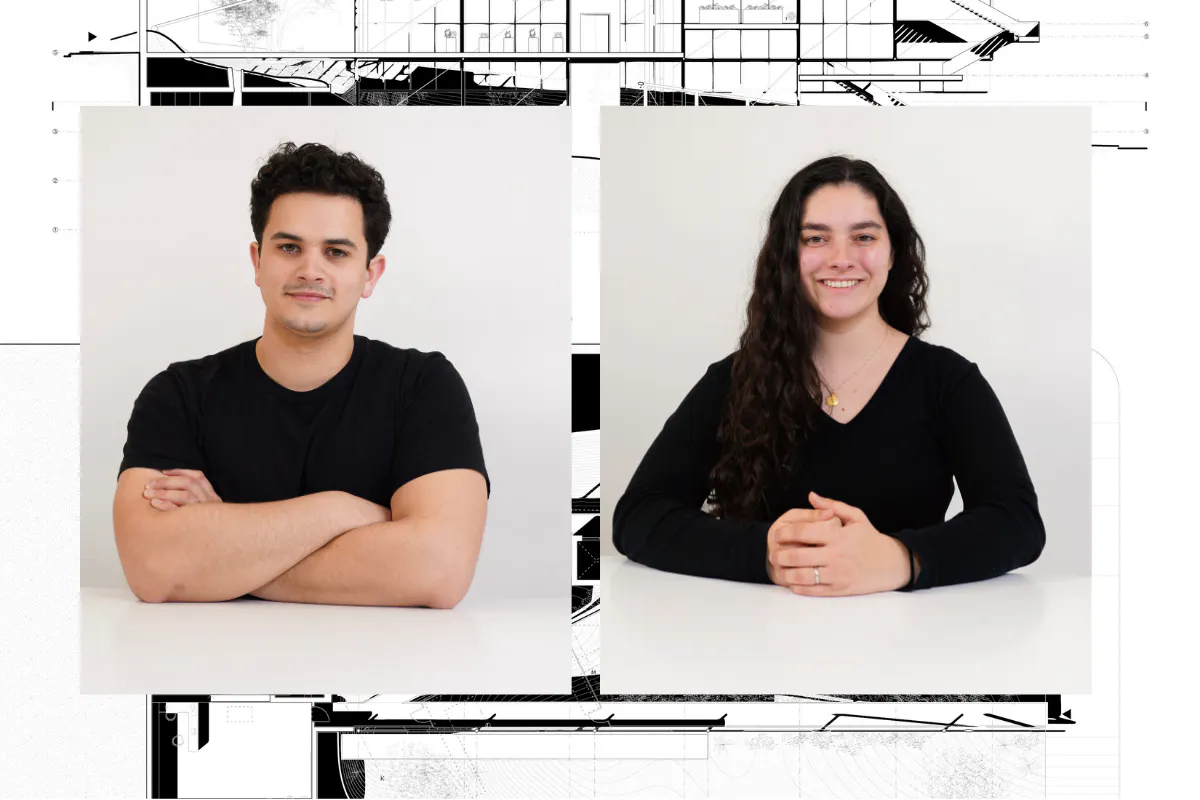
EmaLee and Nabil Davidson met near Lake Tahoe at a Bahá'í gathering focused on the art of meaningful conversation. It was an appropriate beginning for two designers who would spend the next several years thinking together, and with their cohort, about what architects owe to the cities they shape.
Both grew up in Sacramento. Both came to architecture through community college, where they learned critical technical programs Revit and AutoCAD alongside the habits of professional practice. EmaLee worked part-time at a small, woman-owned firm in Sacramento while still a student. She also earned her undergraduate degree in architecture at UCLA. Nabil worked throughout his time as a UC Berkeley undergrad at a small firm, getting his footing in professional practice. They arrived at UCLA's graduate architecture program — the MArch, a three-year professional degree — already married, already practiced and already fluent in the materials and constraints that other students were just beginning to encounter.
This year, Metropolis magazine named them both to its annual Future 100 list — a national recognition of the top emerging design professionals, including 25 graduate architecture students, in the United States and Canada, selected from faculty nominations across North America.
Their three years at UCLA have been dense with opportunity. Working with their studio instructor and Architecture and Urban Design (AUD) vice chair Kutan Ayata, both are completing a yearlong research project set in a speculative 2066. The prompt was to imagine L.A. 40 years from now as if it has already happened. They've been building from a moment when climate, urban policy and the American landscape have all shifted in ways that are still unfolding now.
EmaLee's focus is on the background characters of Los Angeles — the cracked stucco, the brick facades held together with seismic tie-backs, the MacGyvered and the overlooked.
The connective tissue across all of their work is a shared design method they call "formatless" — a practice that refuses to be defined by any single medium or method, that includes treating digital tools as a continuous material that can move between drawing, model and built form, rejecting the friction of translation.
Architecture, they argue, is less about style than about spatial affect — what it feels like to move through a tall narrow room, or to enter a building through a chain-link facade that moves like fabric. Where EmaLee's Sacramento training was grounded in technical precision, UCLA pushed her toward the kind of design theory that produces spaces people seek out rather than simply occupy.
"Be careful what you design, it might just get built," she said, quoting a sentiment from a community college professor that she's carried with her for years.
"I'm interested in the stuff that nobody thinks about, but everybody actually interacts with," she said.
Nabil agrees. "Our generation of architects believes the found condition has stuff on it, and that has to be part of the design approach," he said. Architects, especially those working in a city like Los Angeles, are never working with a blank slate.
His research for his final studio work probes oil infrastructure and refineries. He views them as vast forbidden zones that shape the local environment without ever allowing the public inside.
Beyond the studio, they've taken on other high-profile opportunities. Nabil spent the summer of 2025 working on an art installation for Coachella by UCLA AUD alumni Benjamin Freyinger and Andrew Holder of the Los Angeles Design Group, an architectural practice known for merging historical ideas with contemporary urban challenges.
When New York-based architecture firm FORMA was invited to participate in the Chicago Architecture Biennial, AUD professor and FORMA co-founder Miroslava Brooks brought EmaLee on to work on their piece titled "Commons Reimagined: Collectivity Through Space." Designed to be touched, rearranged and shared, the installation encouraged physical engagement and social interaction, reclaiming play as a civic and spatial act. The pair has also contributed to multiple exhibitions at UCLA itself, including one supporting the school's accreditation review by the National Architectural Accrediting Board, which evaluates every professional architecture program in the country on a regular cycle to verify that students are meeting rigorous licensure standards.
After graduation, they'll teach in TeenArch, the School of the Arts and Architecture's popular annual summer intensive course for high school students. They'll return to Northern California to join a startup. Eventually, the plan is to establish a practice of their own.