Stories Worth Telling
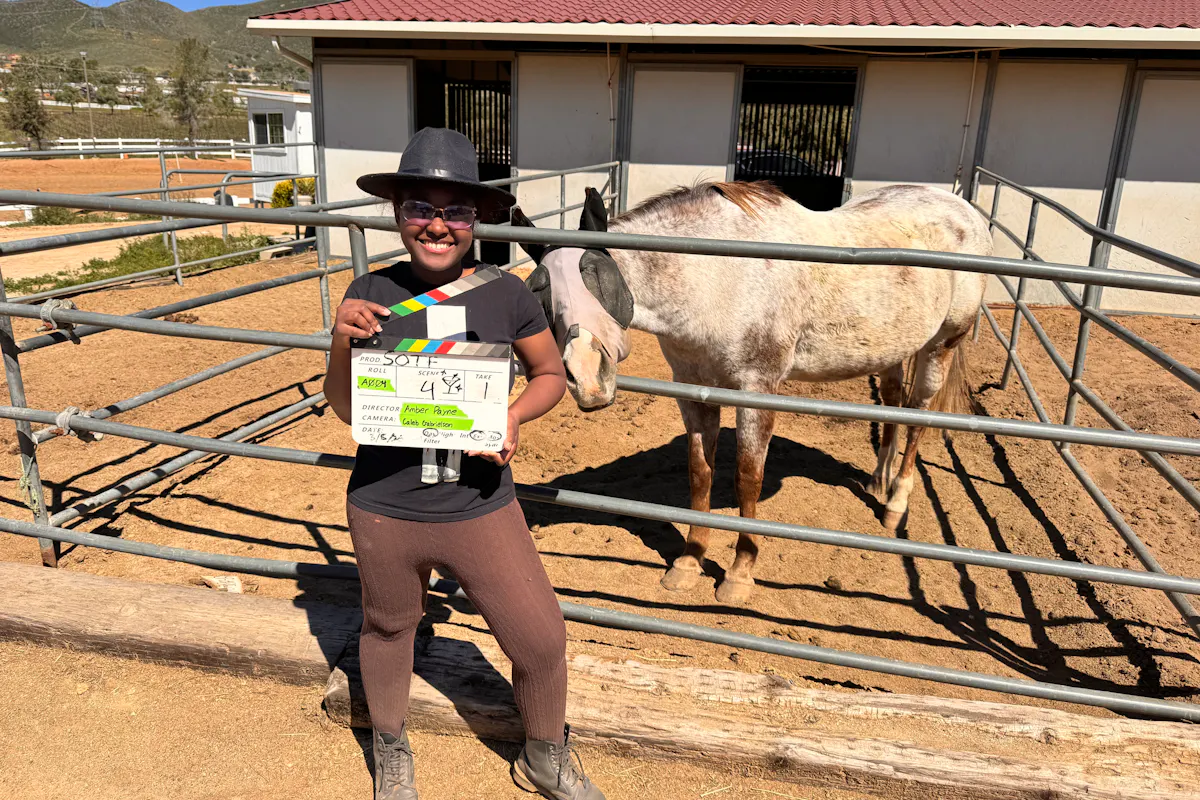
Amber Payne grew up on the South Side of Chicago, attended the Chicago Academy for the Arts, and spent most of her senior year of high school pointed east — toward Yale, Howard, Brown, Northwestern, the schools that felt like destiny from a distance.
But as she got more serious about what kind of filmmaker she wanted to become, something kept pulling her west, magnetized by UCLA’s School of Theater, Film & Television. The weekend of final decisions, her mother asked what plane tickets looked like. Payne took a one-day trip to UCLA, toured the campus, and called home from on the grounds. “What size do you want your UCLA Mom shirt?” she said.
That was that.
It wasn’t just the campus or the city. It was history. Payne had learned about the L.A. Rebellion — the wave of socially conscious, formally daring filmmakers who came through UCLA in the late 1960s and ‘70s, many of them Black and from the Global South, all of them making work that looked nothing like Hollywood. Julie Dash. Charles Burnett. A tradition of independent filmmaking rooted in personal experience and political conviction.
“TFT fosters independent filmmakers and just the passion for storytelling,” Payne said. “I felt I would really fit in here.”
She did. And then she built something to make sure others would too.
In her sophomore year, Payne met a Black senior in the film program who told her something that stopped her cold. In three years at TFT, he said, he had never met another Black undergraduate film major. Around the same time, she met students who loved filmmaking but had few or no resources and no community behind them. She founded the Black Film and Theater Initiative — BFTI — creating a space for Black filmmakers and culturally driven storytellers to find each other and build a network of support, a roadmap drawn by the filmmakers of the L.A. Rebellion.
During her time at UCLA’s School of Theater, Film & Television, Payne has built a body of work shaped by family history, Black cultural memory and genre storytelling that moves fluidly between horror, fantasy and historical fiction.
Her short “Haima” is a horror film about Black vampires set in 1980s Chicago. She’s developing the full-length feature now. Her senior thesis film, “Shadows on the Frontier,” is a horror Western about Black cowboys and family lineage, shaped by stories her Mississippi and Georgia family carried north with them. Both projects reflect what Payne has become clear about: she wants to tell Black stories from the past and the future, in genres that don’t usually make room for them.
That clarity led her to a course taught by Tananarive Due, the author, screenwriter and UCLA lecturer whose course on Black horror became one of the defining experiences of Payne’s undergraduate years. Due brought her on as a PA on a short film set, and later connected her to a freelance writing position at MonkeyPaw Productions — Jordan Peele’s company.
“I owe a lot to her,” Payne said.
Payne officially graduated after Winter quarter and her film work was screened at school’s director’s showcase in June. Her final months as part of the UCLA community had a full-circle quality. This spring she sat down to interview scholar Josslyn Luckett — whose book “Toward a Perfect Rebellion” chronicles the founding generation of the L.A. Rebellion — to discuss what that legacy means for filmmakers like her, now as part of a schoolwide speaker series.
It was the L.A. Rebellion that first made UCLA feel like the right place. And now, Payne is part of the conversation about what comes next.