The Songs We Carry
It started with a text from a stranger. Mickey Hashim had watched Gael Saldana's junior recital on a projector in his apartment. Drawn in by the music, he reached out afterward to ask a question. Would Saldana be willing to write music for a Southeast Asian cultural celebration he was putting together?
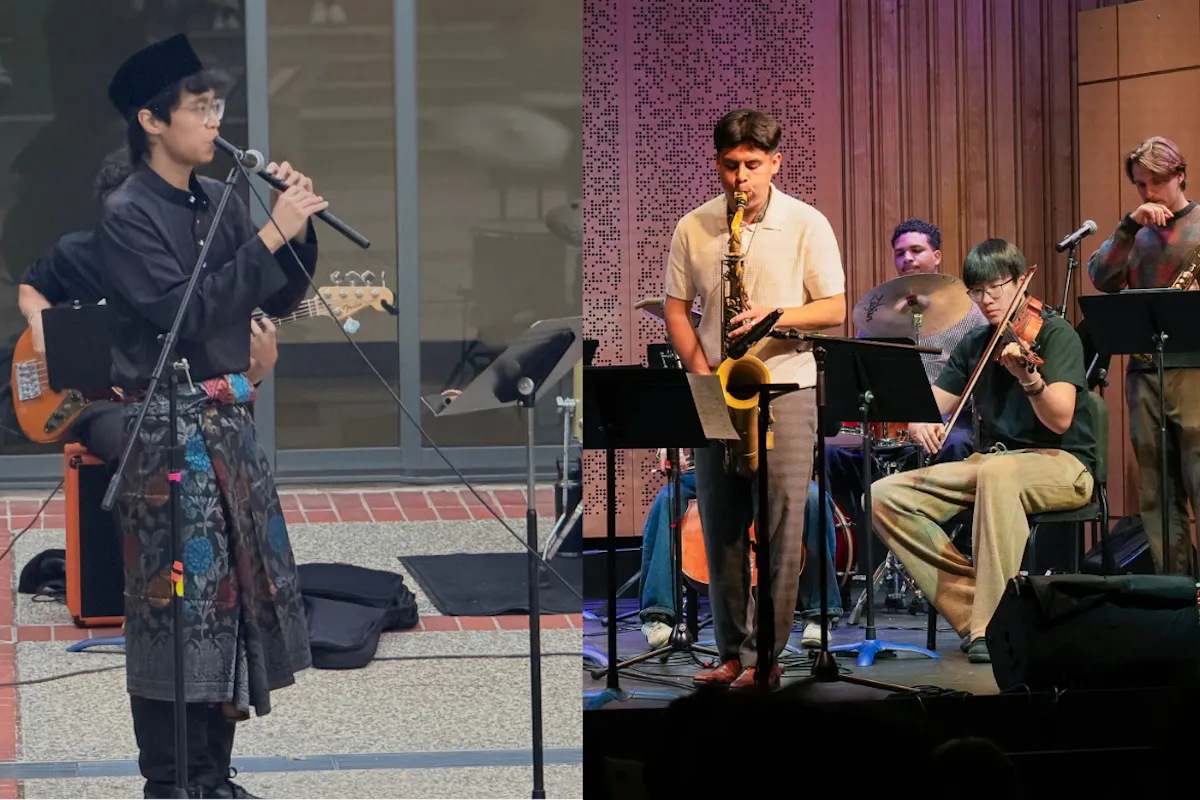
Saldana said yes. And the result was Southeast Asian Fest (or SEA Fest). Held at the Fowler Museum in spring 2025, SEA Fest was a full cultural festival showcasing traditional and contemporary Southeast Asian performance, anchored by a jazz orchestra for which Saldana arranged Filipino and other regional folk music alongside original compositions.
Hashim and Saldana had orbited each other at The UCLA Herb Alpert School of Music without ever really connecting. Saldana grew up 40 miles east of campus in Pomona, California, playing jazz saxophone in middle school with the Youth Orchestra of Los Angeles before arriving at UCLA to study global jazz. Hashim traveled considerably farther, from Malaysia and London, initially on a presidential STEM scholarship before switching to ethnomusicology, the field where his two passions, music and mathematics, found a common language. Hashim grew up playing saxophone and piano in the classical tradition before ethnomusicology expanded what he thought music could be. Studying at UCLA was the first time he had heard Malaysian music performed outside of Malaysia.
For SEA Fest, Saldana called his grandmother and his mother to ask which songs to include, eventually landing on "Dandansoy," a Filipino folk song that he reworked in his own style. His grandmother's reaction — "this is very different" — was followed by her approval, Saldana joked.
"It was like retelling these stories of Southeast Asian cultural heritage in ways that feel more authentic to us," Hashim said.
Both artists credit UCLA programs for pushing them to stretch their skills. Saldana spent late nights composing for his self-initiated junior recital — a full ensemble performance for string quartet, horn players and rhythm. His goal was to prioritize the emotional rather than the analytical side of jazz, a distinction he thinks sometimes gets lost in how the art form is understood.
"Jazz can be very intelligence-forward," he said. "But honestly, I think it's more of an emotional music." His senior recital, performed at Lani Hall the week before commencement, continued that inquiry with the same broad instrumentation.
Hashim, meanwhile, also organized UCLA's first Pride Ball — a voguing competition held against the Gothic backdrop of Kerckhoff Hall. He showcased his creative practice via a senior recital at the Fowler, where he performed on a series of woodwind instruments from Armenia, China, India and Southeast Asia with jazz musicians in a program rooted in the ethnomusicological coursework that shaped his thinking.
A seminar titled "National Performing Arts in Southeast Asia" taught by professor Supeena Adler, in which he encountered his own culture in an academic context for the first time, was, he said, a turning point.
"I realized I could have a place academically, which meant I could have a place creatively," he said.
After graduation, Saldana heads to Berklee College of Music for graduate study. Hashim is less certain about the immediate path, but clear about the direction — artistic and cultural programming, finding ways to tell stories like the ones SEA Fest did. Both artists hope the festival continues without them. They've already spoken to younger students who want to carry it forward.
"It's not just about the culture," Hashim said. "It's about the sense of community, and the wondrous experience of creating and performing together."