Words for a Graduating Class
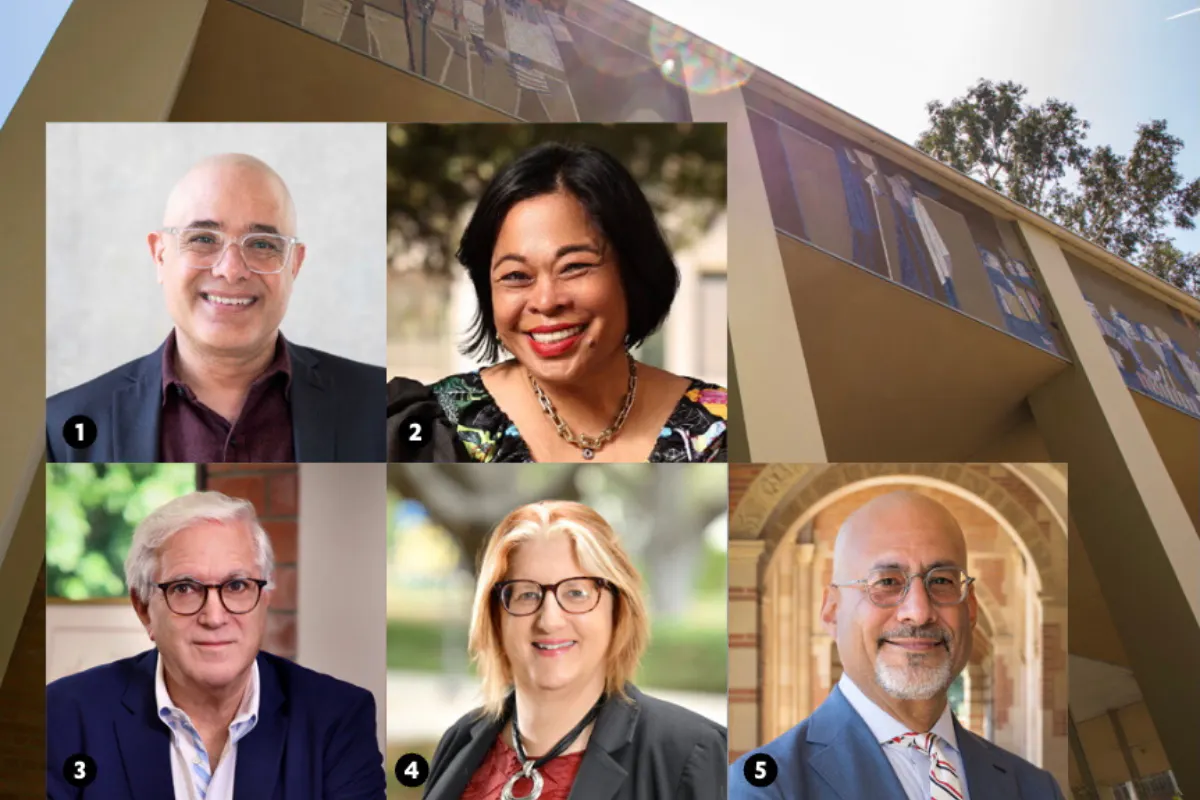
The Class of 2026 arrived at UCLA during a period of enormous change and uncertainty. They now leave as artists, scholars, researchers and thinkers prepared to ask difficult questions and imagine new possibilities. Five UCLA deans share reflections on the graduating class and the futures they hope students will help create.
- Lionel Popkin, dean of the UCLA School of the Arts and Architecture
- Celine Parreñas Shimizu, dean of the UCLA School of Theater, Film and Television
3. Michael Beckerman, dean of The UCLA Herb Alpert School of Music
4. Alexandra Minna Stern, dean of the Division of Humanities, UCLA College
5. Abel Valenzuela, dean of the Division of Social Sciences, UCLA College
What have you learned from the class of 2026? What inspires you about our students?
DEAN POPKIN: This undergraduate class entered UCLA in fall 2022. They came out of high school in the shadow of COVID and have weathered so much in so few years, much of it beyond their control. Yet through it all, they have continued to envision a better world, continued to work on their craft and in their disciplines, continued to ask crucial questions and continued to listen to potential answers.
DEAN PARREÑAS SHIMIZU: This year, I taught several graduating seniors and we studied the iconic L.A. Rebellion filmmaker Julie Dash, who said in a student interview in the 1970s that it is important to speak when you have been spoken for — and that UCLA TFT was where she found freedom to express her ideas. My students claimed that inheritance: just because you don't yet know how to make the films and theater you want to make doesn't mean you shouldn't make it. They are ready to build new and needed institutions through their narratives and scholarship, which makes me hopeful for what lies ahead in cinema and theater.
DEAN BECKERMAN: This is my first year at UCLA, so I don't have the benefit of having known the class of 2026 for very long. Even so, I have already come to appreciate something remarkable about students in the School of Music: their extraordinary breadth and versatility. They have more exposure to and participation in different kinds of music and methods than anywhere else I have been.
DEAN STERN: One of the most inspiring attributes of students in the class of 2026 is their curiosity about the world. I teach interdisciplinary courses in health humanities and environmental humanities, and I am always impressed with how UCLA students — from the humanities and social sciences as well as STEM fields — are self-motivated and passionate about learning new things. I have also been impressed with how adept they are with emerging technologies while remaining thoughtful and critical about them. They want to balance technology with humanistic pursuits rather than let it take over their lives.
DEAN VALENZUELA: Our students are thoughtful, persistent and fiercely creative and innovative. When I engage with them, I am reminded that as difficult and divisive as the present moment may appear, our future is in good hands.
What are your aspirations for the class of 2026?
DEAN POPKIN: That they find a way for the class of 2062 to graduate into a more just world.
DEAN PARREÑAS SHIMIZU: To claim your education, as Adrienne Rich argues in an essay our student leaders read together this year, means bringing what matters to you into everything you make. In every classroom, when students read and write, produce and perform, they author who they are as engaged citizens and learn to hold their power and claim their authority. My aspiration is that they carry forward their wonder and curiosity, their decisiveness and confidence, and their ability to finish their work. I hold in awe the seeds and grains gathered here — to plant, to grow and to make new paths in the world.
DEAN BECKERMAN: Obviously, we want our students to be successful in the fields they have prepared themselves for. But life can take unexpected turns, and we hope they are successful wherever their professional journeys lead them.
DEAN STERN: It is my hope that our 2026 graduates are empowered to navigate the challenges and opportunities of the world informed by their experiences at UCLA, that they find fulfilling professional paths and that they feel personally enriched by the education they have received at UCLA. I am confident they will bring creativity and curiosity to all of their pursuits.
DEAN VALENZUELA: A career that is satisfying, impactful and allows them to form part of the vibrant civic and social fabric that makes UCLA so significant not only in Los Angeles but across the globe.
What's the best piece of advice you ever got when you were a recent grad or before you graduated?
DEAN POPKIN: Make plans, change plans. Repeat.
DEAN PARREÑAS SHIMIZU: Show up for what matters to launch the next thing — every opportunity, every open door and every collaboration that changed the direction of my work began with deciding to go, to make and to speak. Do not wait for the flood. Channel the river. You deserve your dreams.
DEAN BECKERMAN: The best advice I received was this: "All advice is bad advice." It was a sharp reminder that circumstances differ from person to person and every situation is unique. You can learn from someone else's experience, but in the end you have to think critically to determine what is right for you.
DEAN VALENZUELA: When you fall or fail, how you respond and move forward — hopefully with purpose, adjustments and kindness — may set you on a course for fulfillment and better prepare you for life's inevitable, unexpected challenges.
Why do the arts and humanities matter?
DEAN POPKIN: Art is about listening and questioning. As artists we pose questions. We live in questions. We know why questions matter. We know answering them is only part of the process. With AI's dependence on the quality of prompting questions, the arts are more needed than ever. The arts attune our humanity. They help us choose and navigate our world. They are essential for asking the right questions and evaluating the honesty of the answers.
DEAN PARREÑAS SHIMIZU: Moving images on stage and screen transmit feeling across time and place unlike any other medium, giving us language to speak in moments when shared realities are under question and stories are suppressed. You learned your craft here, at the best public film and theater school in the world, and deploying the arts with independence, innovation and impact means serving the public good, including building new institutions and improving the ones that trained you. Your voice rises in constellation with others. This is our TFT banner, now yours to carry into the world: Your Voice. Our Story.
DEAN BECKERMAN: The reason doctors and surgeons keep us alive is so that we can experience the arts. The arts — all the arts — combine reasoning, reflection and aesthetics like no other activity. They introduce us to profound and different ways of seeing and knowing the world around us. Without the arts, we would be lost.
DEAN STERN: The humanities and arts matter because creative expression is a core element of the human experience; helping students find and develop their voices is among the central objectives of a UCLA humanities education.
DEAN VALENZUELA: The arts give meaning to life and all the wonderful cracks, nuances and different spaces that inhabit our planet. The arts generate moments of pause and reflection and allow us to connect more deeply with our varied, complex emotions.
The deans are members of UCLA's Chancellor's Council on the Arts, which also includes:
Zoë Ryan, director of the Hammer Museum
Silvia Forni, director of the Fowler Museum
Edgar Miramontes, executive and artistic director of Center for the Art of Performance
Athena Jackson, University Librarian
May Hong HaDuong, director of the Film & Television Archive
Cindy Fan, vice provost for international studies and global engagement
David Yoo, vice provost of the Institute of American Cultures
Tarell Alvin McCraney, artistic director of Geffen Playhouse.

